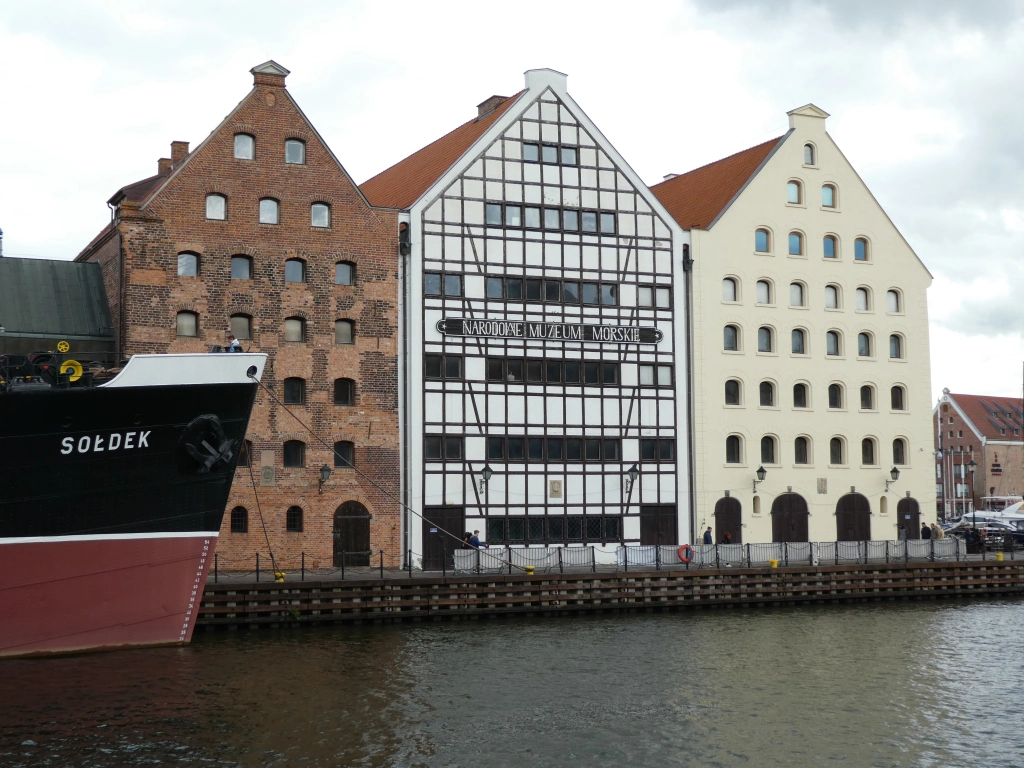
Ninety percent of Gdansk’s old town was destroyed by 1945. The baroque facades, the Gothic spires, the candy-colored merchant houses lining Długa Street — virtually all of it was rubble by the time Soviet troops arrived. What you photograph today was rebuilt brick by brick through the 1950s and 60s, recreated from wartime photographs and 17th-century paintings. Most visitors have no idea.
Picture the standard Gdansk day trip: arrive at Gdańsk Główny station, walk ten minutes to Długa Street, photograph the Fountain of Neptune, buy a piece of amber that may or may not be genuine, eat overpriced pierogi at a restaurant facing the tourist cameras, and take the train back. You’ve seen the facade. The actual city — its history, its food, its politics — stayed hidden.
This is fixable. But it requires knowing what the one-day tourist loop misses, and why.
Why the Standard One-Day Gdansk Loop Leaves Visitors Flat
Długa Street, the Royal Way, is genuinely beautiful. It’s also exactly 300 meters long and takes about 40 minutes to walk at a relaxed pace. One hour is enough. The problem is that it sits at the center of every tour group itinerary, which means everything surrounding it gets treated as approach or departure — not as a destination.
Here’s what gets skipped consistently:
- Westerplatte. A 25-minute ride on Bus 106 (4 PLN each way, departing near the Green Gate) takes you to the peninsula where German guns opened fire on September 1, 1939. The ruins of the Polish garrison are still there. It’s free, stark, and gives the rest of the city its context.
- Oliwa. A separate neighborhood 15 minutes north by SKM commuter rail. The cathedral holds daily organ concerts and the park behind it is one of the best free hours in Gdansk.
- The waterfront south of Żuraw. Walk past the medieval crane and keep going. The area around Ołowianka Island has better river views and a fraction of the crowd.
- Restaurants off the main drag. The markup for a Długa Street view is very real. Three blocks away, the same food costs 30-40% less.
- The Museum of the Second World War. Requires three to four hours and deserves every minute. Most day-trippers run out of time before getting there.
Two full days in Gdansk is the minimum for doing it properly. One day is a highlight reel. There’s nothing wrong with a highlight reel — just don’t confuse it with having actually been somewhere.
Gdansk Attractions: What’s Worth It and What Isn’t
Here’s an honest breakdown of the main attractions with current prices in Polish Złoty (roughly 4 PLN to $1 USD as of 2026) and realistic time estimates.
| Attraction | Entry (PLN) | Time Needed | Verdict |
|---|---|---|---|
| Museum of the Second World War | 35 | 3-4 hours | Essential. Book timed tickets online — summer queues hit 90 minutes. |
| European Solidarity Centre | 30 | 2 hours | Excellent with Cold War context. Less rewarding without it. |
| St. Mary’s Basilica | Free (tower: 15) | 45 min–1 hour | Go. Largest brick church in the world. The interior scale genuinely surprises people. |
| Żuraw (Medieval Crane) | 20 | 45 minutes | Skippable. Better experienced from outside as a photo subject. |
| Amber Museum | 20 | 1 hour | Visit before buying amber jewelry anywhere — it teaches you what to look for. |
| Westerplatte | Free | 1.5 hours | Don’t skip. The ruins communicate something no museum fully replicates. |
| Oliwa Cathedral and Park | Free | 1–2 hours | Worth the detour. Daily organ concerts, peaceful park, almost no tour groups. |
Why the Museum of the Second World War Deserves Half a Day
This museum opened in 2017 and immediately became politically contentious. The Polish government attempted to change its directorship and curatorial direction, arguing the scope — covering the global war rather than only Poland’s suffering — was insufficiently nationalist. The resulting public fight made the museum more famous than it might otherwise have been. The exhibits cover German occupation, Soviet occupation, the Jewish experience, and civilian suffering across multiple countries, without softening the harder parts of Polish history either. Expect to feel unsettled. That’s the point. Book timed-entry tickets through the museum’s official website before you arrive, especially July through August.
Free Attractions That Actually Earn Their Place
Westerplatte costs nothing and belongs at the top of any Gdansk itinerary. The bombed barracks and fortifications are left largely as found, with plaques explaining the seven-day siege the 180-person Polish garrison mounted against thousands of German troops. Bus 106 departs from near the Green Gate at the foot of Długa Street — 4 PLN each way, about 25 minutes. St. Mary’s Basilica is free to enter (the tower climb costs 15 PLN). The vaulted ceiling feels like standing inside an inverted ship’s hull. The 15th-century astronomical clock near the north transept still functions.
Where to Eat in Gdansk: Three Places That Aren’t Tourist Traps
The closer to Długa Street, the higher the price and the lower the quality-to-cost ratio. These three consistently deliver.
Bar Mleczny Neptun (Budget: 15–30 PLN per person)
A milk bar — a Polish communist-era cafeteria format — that survived into the present almost unchanged. Order at the counter, grab a tray, find a seat among locals. The żurek (sour rye soup with hard-boiled egg and sausage) costs 12 PLN. Bigos, the hunter’s stew, is 14 PLN. Pierogi ruskie — potato and curd dumplings — runs about 18 PLN for ten. Bar Mleczny Neptun sits on Długi Targ but faces away from the tourist cameras. If you spend more than 30 PLN here, you ordered a lot.
Pierogarnia Mandu (Mid-range: 35–55 PLN per person)
Specializes in pierogi with fillings beyond the standard: duck with cherries, spinach with goat cheese, pork with caramelized onion. Located on ul. Piwna, a three-minute walk from the main square. Gets crowded at dinner — arrive before 6pm or after 8:30pm. Budget 45–50 PLN per person with a drink. Their traditional potato and curd version is still the best thing on the menu, for what it’s worth.
Brovarnia Gdańsk (Splurge: 70–120 PLN per person)
A brewpub in a restored 17th-century granary on the Motława waterfront. Their house-brewed amber ale is good. The żeberka (braised pork ribs) are better than they need to be for a tourist-area restaurant. Yes, it’s touristy. But the building is a genuine 17th-century structure and the food clears the bar most waterfront restaurants don’t. If you want one restaurant that earns its setting, this is it. For coffee: Café Ferber on ul. Długa serves proper espresso to a mostly local clientele — the most reliable signal a cafe is doing something right.
The SKM Train Is 5 PLN and Changes the Whole Trip
Gdansk is part of a connected metro area called Trójmiasto (Tri-City): Gdansk, Sopot, and Gdynia. The SKM commuter rail links all three. A ticket from Gdańsk Główny to Sopot is 5 PLN and takes 20 minutes. Gdynia costs 7 PLN and 35 minutes. Sopot has Europe’s longest wooden pier (512 meters), a beach resort energy, and a seafront promenade that fills with people in summer. Gdynia is calmer — a planned modernist city built from scratch in the 1920s, with Art Deco port architecture and a working-city feel that’s completely different from the reconstructed old town. If you only have one afternoon, Sopot is the easier call. Gdynia rewards people who specifically like architecture and want to see a city that’s never been on a postcard.
When to Visit Gdansk — and When the Math Doesn’t Add Up
Is summer worth the premium?
July and August deliver reliable weather (18–24°C), long evening light on the colored facades, and Sopot beach at its most alive. They also deliver queues at the Museum of the Second World War that can hit 90 minutes without pre-booked tickets, accommodation costs 30–40% above shoulder season rates, and Długa Street at peak sardine density between 11am and 4pm. Book the museum online, arrive early, and have a plan — summer is manageable with preparation. Without it, you spend a lot of time waiting.
What makes May, June, and September better for most travelers?
Hotel Podewils — a boutique hotel in a restored baroque building directly on the Motława waterfront — runs around €180 per night in August. The same room in September costs €110–120. The Baltic in early September stays 17–19°C, still warm enough to swim in Sopot. Museum queues disappear. Restaurants are easier to book. The trade-off is less predictable weather, though September in Gdansk tends to stay dry until mid-month. For value and comfort combined, late May and early September are the honest answers.
Is winter worth considering?
Only if you specifically want the city to yourself. The old town in December fog is atmospheric in a way summer can’t offer. Major museums stay open on regular hours. Hotel rates drop 50–60% from August peaks. Sopot’s beach is empty and grey, but the pier is still there. Accept that you’re in a Baltic port city in January and dress accordingly — it works as a trip, just a completely different one.
The History Running Beneath Gdansk’s Surface
Gdansk has been German, Polish, Prussian, and sovereign — sometimes within the same decade. For most of its history it was Danzig, a Hanseatic trading city where the width of your street facade announced your wealth to passing merchants. The elaborate stepped gables on Długa Street weren’t decoration. They were status signals in a city that ran on international commerce, amber exports, and Baltic grain trade.
After World War I, the city became the Free City of Danzig — technically independent, not German, not Polish, governed under League of Nations supervision. That status lasted until 4:48am on September 1, 1939, when the guns on the German battleship Schleswig-Holstein opened fire on the Polish garrison at Westerplatte. The war that killed between 70 and 85 million people started at a specific time, on a specific morning, at this specific stretch of Baltic coastline.
By 1945, ninety percent of the city was gone. The German population — roughly 90% of prewar residents — was expelled and replaced with Poles who had themselves been expelled from cities absorbed into Soviet territory: Lwów (now Lviv), Wilno (now Vilnius), and dozens of smaller towns. The people who rebuilt Gdansk’s old town from photographs were not descended from the people who built it. They were strangers who arrived as refugees and decided, nonetheless, to reconstruct something that looked like what stood before.
Then in 1980, the city produced another rupture. The Lenin Shipyard in Gdansk became the origin point of Solidarity — the trade union movement led by Lech Wałęsa that pushed through strikes, martial law, and a decade of political pressure to the negotiating table that began unraveling communist Eastern Europe. Gate No. 2 of the shipyard, where workers posted their 21 demands in August 1980, is preserved at the European Solidarity Centre adjacent to the original site. The building’s rusted-steel exterior deliberately echoes shipyard hull-plate construction. Inside, the exhibits trace the movement from its first illegal meetings through Wałęsa’s 1983 Nobel Prize to the collapse of communist rule in Poland — without sanitizing the compromises and internal conflicts along the way.
All of it — Hanseatic wealth, contested identity, total wartime destruction, refugee reconstruction, and political revolution — compressed into a city of 470,000 people on the Baltic coast. Walking Długa Street and feeling like you’ve seen Gdansk is a specific kind of mistake. You’ve seen the reconstruction. The city runs exactly as deep as it ran on the morning ninety percent of those facades were reduced to rubble — and understanding that changes everything about how the rebuilt streets feel beneath your feet.