I spent four days in Helsinki last summer running the standard circuit — Market Square, the cathedral, Suomenlinna, a sauna. On my last free morning, with nothing left on the list, I took the metro west. That 18-minute ride to Tapiola changed how I think about what a city can be.
Why Most Visitors Skip Tapiola — and Why That’s Their Loss
Tapiola is not a tourist attraction. Go anyway. There are no queues, no gift shops selling Moomin mugs, no audio guides. It’s a planned residential district in Espoo built between the 1950s and 1970s as Finland’s answer to the Garden City movement — and it happens to be one of the most carefully designed urban environments in Northern Europe.
The brief was radical. Housing reformer Heikki von Hertzen insisted that Tapiola wouldn’t become a dormitory suburb. It needed shops, schools, a church, cultural buildings, and direct access to forest — all within walking distance of each other. The architects who delivered it include Aarne Ervi and Aulis Blomstedt, two of the most significant modernist designers in Finnish history.
Walking through it today, the scale feels human. Trees grow into the gaps between buildings. The Tapiola Church sits beside a small pond called Hepokulta and looks like nothing you’d see elsewhere in Finland. What you’re experiencing is a serious attempt to answer a serious question: how do you build a city where ordinary families can actually live well?
It worked. Which makes it worth the ride.
What Separates Tapiola from Other Espoo Suburbs
Espoo is Finland’s second-largest city, but most of it is unremarkable post-war expansion. Tapiola is the exception — a district with a clear spatial logic, civic ambition, and enough surviving original architecture that you can still read the original plan just by walking through it. Nearby Espoo neighbourhoods like Leppävaara or Matinkylä are standard commercial strips. Tapiola has a centre that feels designed rather than accumulated.
The other differentiator: EMMA — Espoo Museum of Modern Art sits here. One day gives you a significant modernist architecture walk and a serious contemporary art museum, without crowds. That combination doesn’t exist anywhere else this close to Helsinki.
Who Should Actually Make This Trip
If you’ve done the main Helsinki sights and want something that feels less packaged, Tapiola is the right answer. It rewards people who like walking through cities slowly, looking at buildings, and spending time in galleries without fighting for space. If your priority is beaches or wild nature, Nuuksio National Park — 30 minutes by bus from Espoo centre — is a better fit. These are genuinely different kinds of trips.
Getting from Helsinki to Tapiola
Take the West Metro (Länsimetro) from Kamppi or Ruoholahti in central Helsinki and get off at Tapiola station. Journey time from Kamppi: 18 minutes. If you’re on an HSL day ticket covering A and B zones, it’s included. A single HSL ticket runs around €3.20 in 2026. The station exits directly into the Tapiola commercial centre. No taxis, no transfers, no advance planning needed.
One bonus stop worth knowing: Aalto University station, one stop before Tapiola, is itself an architectural statement — designed by ALA Architects and opened in 2017, it’s one of the more dramatic metro stations in Finland. If you’re interested in contemporary Finnish design, exit here briefly before continuing to Tapiola.
The Architecture That Makes Tapiola a Genuine Pilgrimage
The Garden City Logic — Why It Looks the Way It Does
Most planned suburbs built in the 1950s and 60s aged badly. They became car-dependent sprawl or were demolished as soon as municipalities could afford to replace them. Tapiola survived because the fundamental idea was different.
Von Hertzen believed that working-class Finnish families deserved the same quality of environment that wealthy Finns built for themselves — forests, ponds, well-designed public spaces. He got individual architects to compete for individual buildings rather than handing the whole development to one firm. The result is a district with genuine variation, where each civic building is a considered design rather than a unit repeated forty times.
The residential blocks between the centre and the forest edge — particularly along Tapionraitti and Merituulentie — show the domestic scale clearly. Most are four to six storeys, set back from pedestrian paths, with mature trees filling the gap between building and street. Some are better maintained than others. But the spatial logic holds throughout: you’re never far from either a civic space or a forest path. That’s not an accident. It was specified in the original plan and enforced through decades of development controls.
Buildings Worth Seeking Out
Start at the Tapiola water tower at the heart of the centre. Aarne Ervi designed it as a civic landmark rather than just infrastructure, and the proportions are clean enough that it works as both. Walk the base and you have an immediate orientation of the whole district.
From there, take the ten-minute walk to the Tapiola Church at Tapiolantie 4. Completed by Ervi in 1965, the bell tower is a thin concrete needle rising from a low horizontal base — arresting against the treeline and still looking contemporary sixty years later. The interior is white, spare, and quiet. Go inside if it’s open; the relationship between the ceiling height and the light coming in from the south is worth a few minutes on its own.
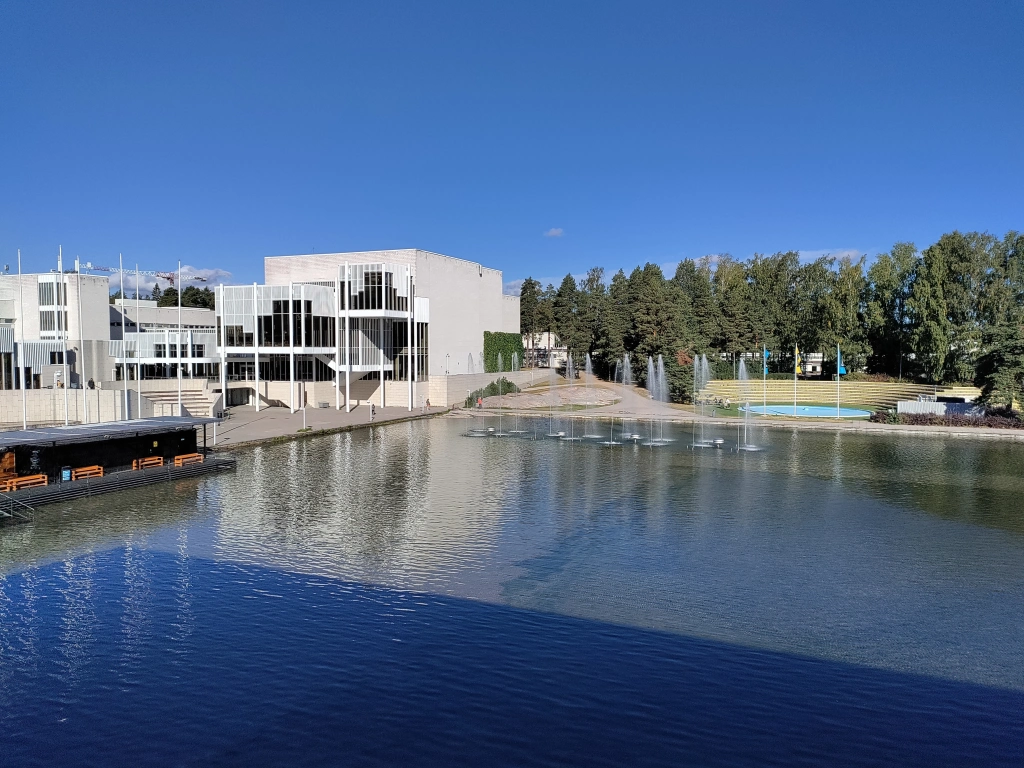
The Espoo Cultural Centre (Kulttuuriaukio 2), designed by Arto Sipinen and completed in 1989, is a later addition to the original Garden City plan but integrates well. The terraced plaza in front is the best single spot to stand and take in the commercial centre as a whole. The building hosts concerts, theatre, and rotating exhibitions — check the programme at espoonkulttuurikeskus.fi before you visit, since something is usually running.
The One Mistake Architecture Visitors Make
Going straight from the metro to the museum without walking the residential streets. The museum is worth your afternoon. But the reason Tapiola exists as a destination is the built environment, not EMMA. Walk through the housing blocks north of the centre. Look at how forest and building alternate without hard edges between them. That spatial sequence — civic space to residential street to forest path in under ten minutes — is the actual thing Tapiola achieved. You can see Finnish contemporary art in Helsinki any day. You can’t see this anywhere else.
EMMA and the WeeGee Centre — What’s Actually Worth Your Time
Is EMMA Worth the €15 Ticket?
Yes, clearly. EMMA — Espoo Museum of Modern Art is housed in the WeeGee Exhibition Centre at Ahertajantie 5, a ten-minute walk from Tapiola metro station. Adult admission is €15. The permanent collection concentrates on Finnish modernism and Nordic contemporary art, with strong holdings in photography, sculpture, and painting from the 1950s to the present. Temporary exhibitions are well-curated and typically more adventurous than what you’d find in the safer programming of Ateneum in Helsinki.
The building itself — a converted 1960s industrial warehouse with a clean gallery fit-out — is worth noting. The ceiling heights work particularly well for large-format work. Budget 90 minutes minimum to cover the permanent collection and one temporary show properly.
What Else Is in the WeeGee Building?
WeeGee houses multiple institutions under one roof. Alongside EMMA, the Espoo City Museum occupies part of the ground floor. It’s small — 30 minutes covers it comfortably — but genuinely useful if you want to understand how Tapiola was built. Original planning documents, architectural drawings, and period photographs are on display. If you walked the residential streets first and found yourself curious about what you were seeing, this adds the missing context.
Combination tickets are available at the front desk. Ask about current pricing when you arrive, as EMMA occasionally runs special exhibition surcharges on top of the base admission.
Do I Need to Book in Advance?
No. Walk-in works on any weekday without issue. Weekend afternoons between 11am and 2pm are slightly busier, but nothing requiring advance tickets. EMMA is closed Mondays. The WeeGee ground-floor cafe is functional for a coffee break — nothing memorable, but the tables near the window are a decent place to sit between galleries.
Eating and Walking in Tapiola
Food options near the centre, ranked by practicality:
- WeeGee cafe (ground floor): decent coffee, open sandwiches. Use it for a quick break during the museum visit. No reason to make a trip specifically for it.
- Restaurants on Kulttuuriaukio plaza: several places with rotating lunch specials in the €12–16 range. Good for a proper sit-down meal between the architecture walk and the museums. The plaza itself is worth lingering in — good people-watching and a clean view of the Cultural Centre facade.
- S-Market in the Tapiola shopping area: Finnish supermarket lunch is underrated and cheap. Open-faced sandwiches, pastries, and ready meals run €4–7. Works well if you want to eat on a bench in Hepokulta park rather than in a restaurant.
For walking, two routes are genuinely worth doing:
- Hepokulta pond loop: 1.7km, flat, fully paved, starts five minutes from the Tapiola Church. Easy to slot between the architecture walk and the museum visit without it feeling like a separate excursion.
- Tapioksen puisto forest trails: head north from the metro station on foot. The trail network is well-marked and you’re in actual pine forest within ten minutes of arriving in Tapiola. Longer routes connect further into Espoo’s green belt if you want to extend the day.
The Ainoa shopping centre sits just east of the Tapiola centre — standard Finnish mall, nothing worth a specific visit, but useful if you need an ATM, a pharmacy, or somewhere to wait out rain before heading back.
A Full Day Itinerary for Tapiola
This schedule assumes a 9:30am departure from central Helsinki and returns you by mid-afternoon with the evening free:
| Time | Activity | Location | Notes |
|---|---|---|---|
| 9:30 | Depart Helsinki | Kamppi metro station | West Metro, direction Tapiola |
| 9:48 | Arrive Tapiola | Tapiola station | Exit straight to street level |
| 9:50–10:50 | Architecture walk: centre, water tower, residential streets, church | Tapionraitti + Tapiolantie 4 | Tapiola Church opens at 10am most days |
| 10:50–11:05 | Walk to WeeGee through park | Ahertajantie 5 | Follow signs from church area |
| 11:05–12:30 | EMMA permanent collection | WeeGee, upper floors | €15 adult; no booking needed |
| 12:30–13:00 | Espoo City Museum | WeeGee, ground floor | Combo ticket available at desk |
| 13:00–13:45 | Lunch | Kulttuuriaukio plaza or WeeGee cafe | Budget €10–16 |
| 13:45–14:30 | Hepokulta pond loop | Near Tapiola Church | 1.7km, flat, fully paved |
| 14:30–15:15 | Free: forest trails or EMMA temporary show | Tapioksen puisto or WeeGee | Depends on what EMMA is currently showing |
| 15:15 | Return metro from Tapiola | Tapiola station | Back in central Helsinki by 15:35 |
If EMMA has a strong temporary exhibition running, add an hour and cut the free time block. The architecture walk at the start of the day is the non-negotiable part — everything else shifts around it.
I got back to Helsinki just after 3pm that last summer morning, walked past the Market Square one more time, and felt like I’d actually understood something about how Finns think about building places to live. The museums were good. The architecture was better. But it was the scale of it — the way forest and civic space coexisted without either one colonising the other — that stayed with me. That’s what the metro ride is for.